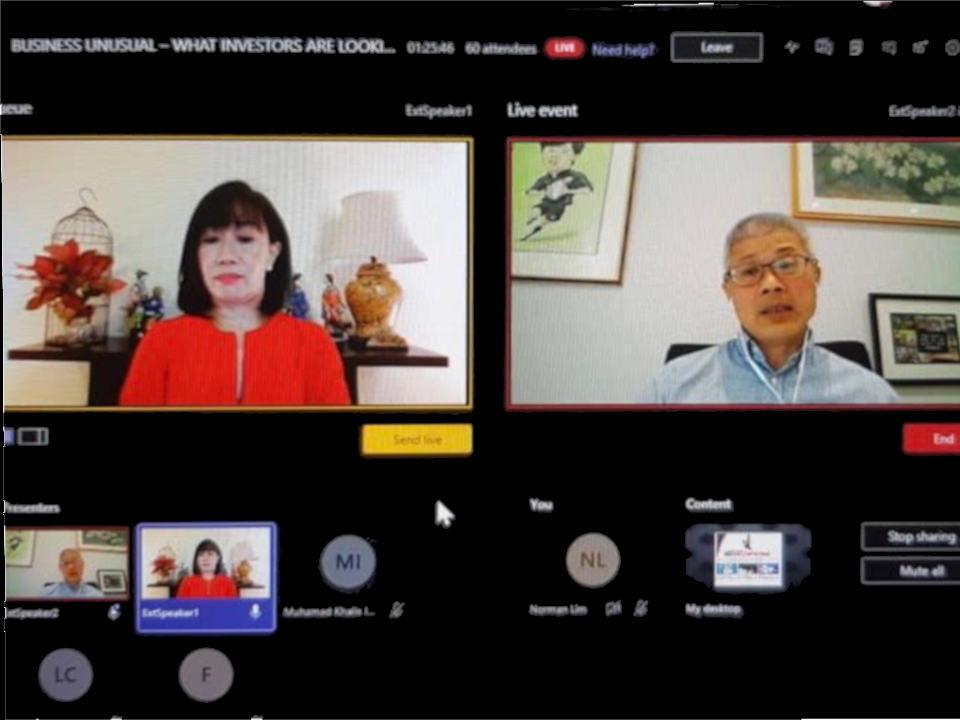
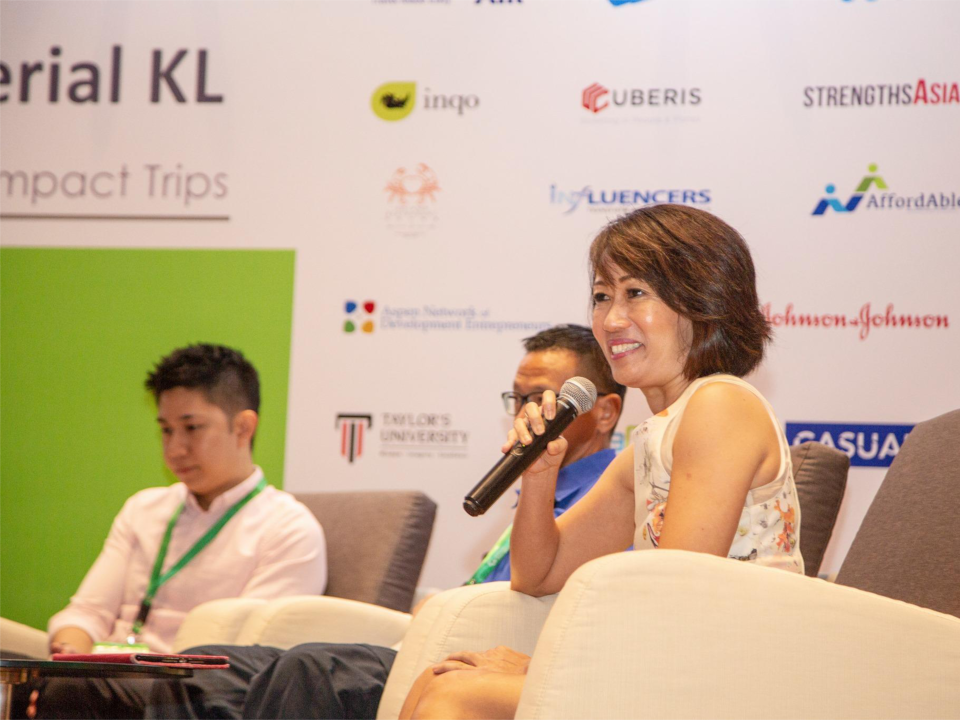
Having started on webinars and virtual workshops, as most people did, at the start of the lockdowns, I was a noob at it. At least that’s what I thought.
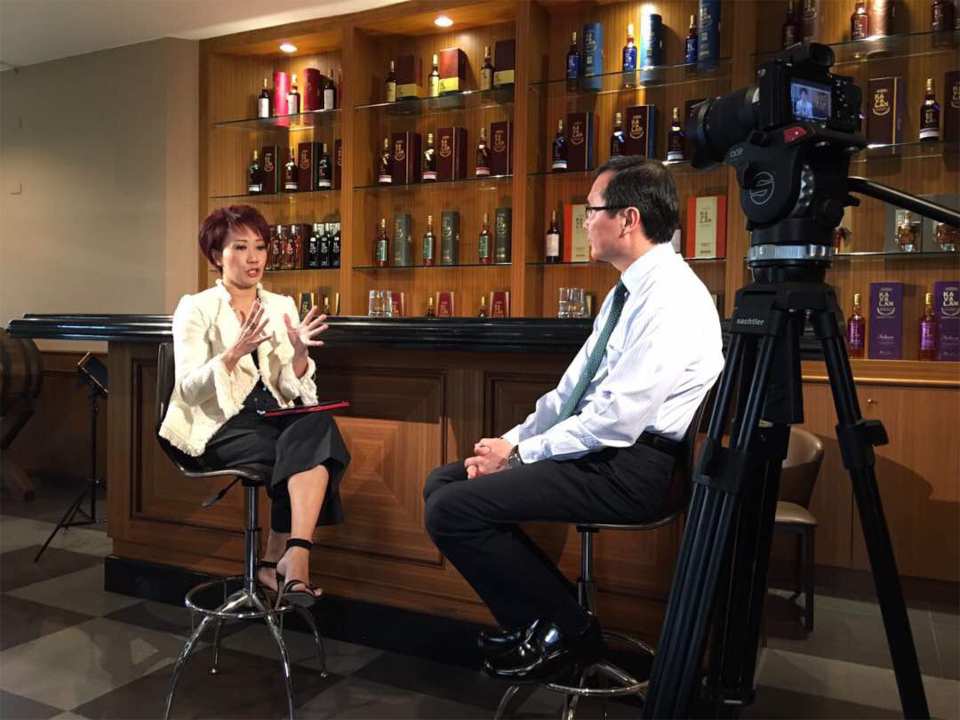
As I got into the groove, I found many practices vaguely familiar. Then it hit me like a bolt – it’s television presentation all over again!
No wonder it was all so strangely familiar.
So, I’ve settled myself in very nicely with the advantage I have with years of television hosting.
Here’re a few tips that I’ve adopted and refreshed for presenting virtually.
Keep the one-way communication short
In a 30-minute programme, like Power List Asia, which I hosted for six seasons, there’ll always be two commercial slots fitted in – usually after eight minutes (if the math isn’t adding up for you, commercials take up about six minutes in total). So three eight-minute segments are produced with each having its own story arc and cliffhanger. The timing has been refined over the years considering the average attention span of a viewer.
This is confirmed by John Medina, professor of neurology at University of Washington, in his book Brain Rules. Medina says we can really only pay sustained attention to a consistent pattern for about 10 min before the mind wanders.
So, practice and theory converge to tell us to keep your spiel to less than 10 minutes at a go.
Here’re other considerations in an online setting that change the rules we normally play by in a physical context. The decorum our audience maintain by paying attention in a physical setting, is partly attributed to putting up appearances for people around them. Now that the witnesses are no longer there, the crime is free to commit. They can turn off their videos and hide their lack of interest to the drone on the other end of the line. That missing accountability coupled with the multitude of distractions at their workstations make it extremely challenging for a speaker to hold their attention.
If you can’t keep it that short, keep it varied.
Variety is the spice of life – and attention. Change the visual impact by mixing up your slide templates – textual, image, graphs, quotations, videos. Don’t forget to swap the image back to you by stopping the slide share even mid-way through the presentation when a discussion is happening, This will help to focus your audience’s attention on you and the exchange of ideas among the participants.
If it’s a group presentation, tag the other presenter at about the eighth to tenth minute. Introducing another speaker, even if it’s to give a testimonial, will be a helpful stimulus to recapture interest.
In a training scenario, I build in mini exercises and break out into smaller groups more often than in a physical setting.
Hearing other voices helps: I call on participants to share their perspective. Of course, the onus is on me to craft provocative questions to elicit a conversation. Having a co-trainer chime in with a different perspective and take over at different times, if you can afford it, helps to keep the workshop going for as long as one and a half days.
Use your to voice to captivate
I have huge respect for radio presenters. One of their biggest challenges is the fact that they have nothing but their voices and content to grip the listener. In television hosting, we have the added advantage of half our bodies to convey our message. It still does not negate the need to modulate our voices as we relate a story.
Varying your pitch, pace, volume and adding rightly-timed pauses are par for the course for building expression and repertoire to your vocal delivery.
I recommend recording yourself by reading out loud for about five minutes, playing it back and assessing how alive you sound. Mark out the article you’re reading with indicators like
“//” to indicate pauses (usually between paragraphs),
underline words that make a difference to the meaning.
“()” for sentences that you can read quickly
highlights for conclusive statements that require a slower pace
? for a happy note
? for a serious note
Practise regularly. Good vocal variety does not happen overnight.
The acid test – if you do lose interest in yourself during playback, then you need to work harder. You could also let someone else listen to the recording for a more objective assessment.
Work doubly hard to be energetic.
With enough distractions in your listener’s field of vision, speakers must muster enough energy for it to be felt through the camera onto audiences’ devices. I found standing throughout my delivery a sure-fire way for me to keep up the verve. If I can take it easier – during a discussion, for instance – I would lean on a high stool for support and stand again when it’s show time. Nevertheless, I highly recommend standing when you’re presenting virtually. The difference you’ll feel is significant. More importantly, how your audience feels is crucial.
I’ve been framed!
The power of physical meetings is the advantage to use our entire body to communicate – from the way we angle our feet and torso to the way our arms work with our facial expressions and the freedom to shift our positions for variety and meaning. Video conferencing, for the most part, removes those advantages from us with the limitations of our webcams and physical space. You could say our webcams disembody us. For some of us, we become, literally, a talking head, while others, a live bust, visible from head to upper chest.
Here’s what I’ve learnt from my experience as a news anchor: studio directors have generally agreed that the more of the presenter is seen, the greater the presence. So, given that we are most often seated throughout the entire show, the best framing would be to have the presenter be seen from head to waist.
I’ve found that standing a distance away from the webcam to capture my gestures as I speak, has helped me to communicate with my upper body, and not just with my facial expressions.
To do this well, keep your camera lens at eye level so you’re not looking down nor up, but straight ahead. This may mean raising your device and not merely tilting it. You’ll know if it’s level when the vertical lines around you are perpendicular to the bottom of your frame.
Watch your backdrop
My webinar backdrop. Plant from my garden to add some height variation to the image. Note the improvised backlighting – a common feature in TV interviews
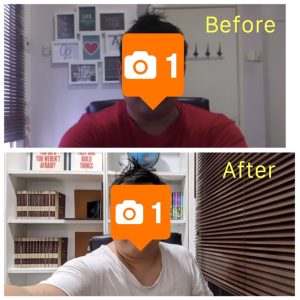
For our television interviews, the producer would recce the location days ahead to ensure we have the right spot for the conversation. There’re many considerations and if most of the boxes are ticked but not the backdrop, the crew would turn up hours ahead of time to set it up. Furniture would be moved, plants from the garden brought in, articles in the room shifted to that right spot for the frame. Your backdrop is to your image as accessories are to your outfit – they complement and enhance your look. The bookshelf behind the speaker suggests someone who is erudite and learned. Defocused photo frames on the wall expand my perspective of the speaker to the relationships and interests he has outside of the professional context. It doesn’t have to be an expensive set up. Just a considered, intentional arrangement that’s non-distracting.
Avoid virtual backdrops. They cut out parts of your image when you move and they’re just passe and simply too expedient/lazy.
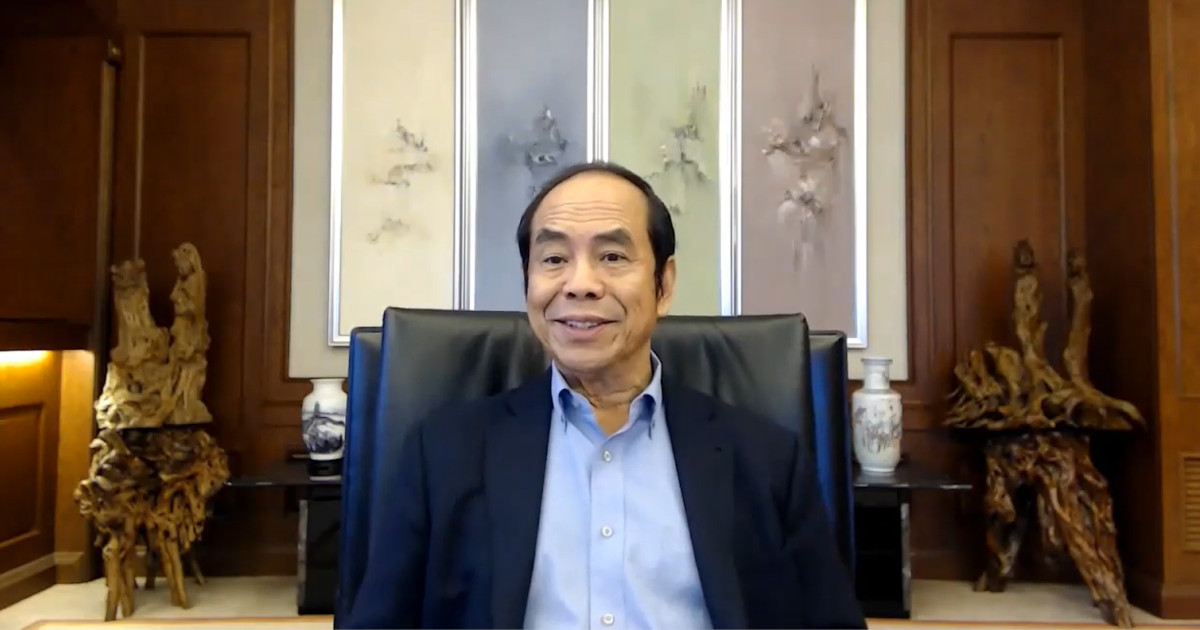
Worked with a CEO of a tech company to set up the most appropriate backdrop for his high level discussions from his home
Ensure adequate lighting
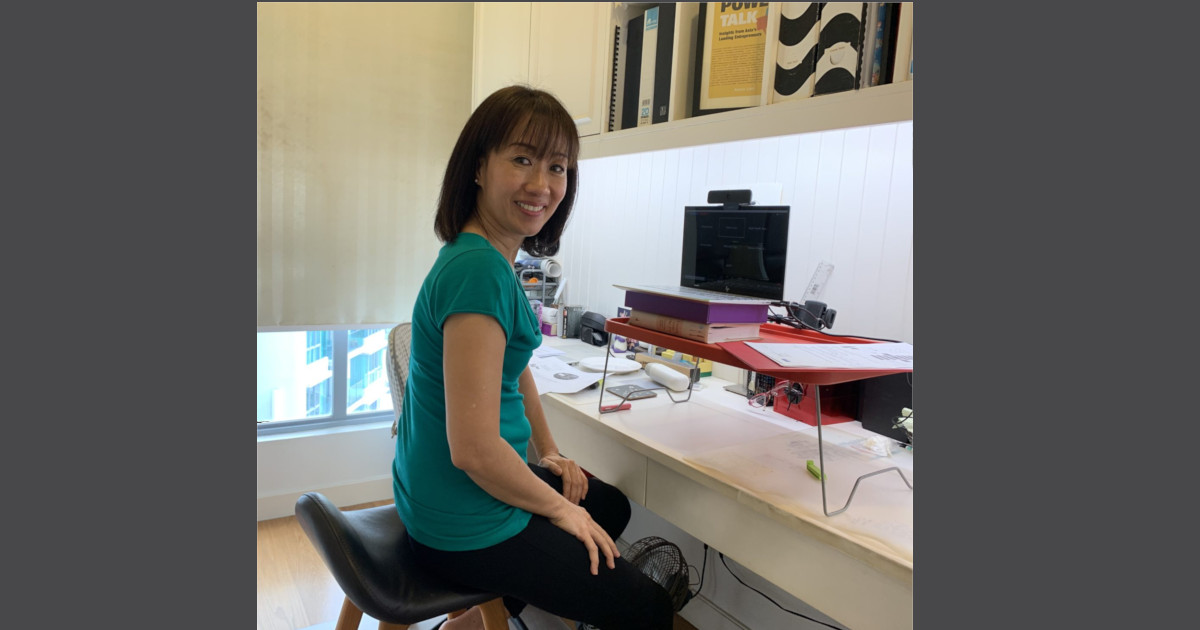
Your main visual communication is your face. So, make sure you’re properly lit with the lighting in front and not behind you. If you’re fortunate enough to have your workspace well lit with natural light, good on you. If you don’t, you can get those halo selfie lights (I hear they’re flying off the shelves, so don’t be embarrassed about buying them) or just a standing or table lamp. To make the light less blinding on you and harsh on your image, get some baking paper or tracing paper to cover the lamp to diffuse the light source (improvisation is the order of the day!) White or day light is what I would recommend for a more natural look.
I happen to have concealed lighting at my workstation behind my webcam. The light bounces off the white panel in front of me to give my face good exposure without the harshness of direct lighting.
With these tips, you should be on your way to hosting your own Youtube channel soon!
16 June 2020 — At 65, Dr Kim Tan is riding on the third wind of his career. Having started out as a biochemist before becoming a biotech venture capitalist, he had thought retirement in 2003 would slow things down for him. But it was not to be. “Retirement is hard work!” he declared when I met him at the Royal Society of Medicine in London where he’s a Fellow. He welcomes me warmly, offsetting the mad-professor image that he cuts with his tousled salt and pepper hair. I was mindful that I had about an hour with him before he had to scoot off to a talk he was giving at the British Malaysian Society.
Kim Tan (right) chatting with my husband and me at the Royal Society of Medicine.
Marathon runners would understand the significance of the third wind – that last burst of energy that surges through the body just when they think they’ve all but burnt it out. Ask him how busy he is today and Dr Tan answers in specifics – he has an average of 80 emails in his inbox daily, he travels for board meetings, meets with his multiple investees, gives talks and teaches in bible schools. Everyone wants a piece of him as he sits as chairman of Springhill Management (UK), Inqo (SA), Garden Impact Investments (Singapore), partner of Novastar Ventures (Kenya) – companies that manage funds for social impact investing, some of which include the sovereign funds of Norway and UK that lead investments alongside foundations like the Bill and Melinda Gates Foundation and Chan Zuckerberg Initiative. He is also an advisor the the Johnson and Johnson social venture fund and the leading proponent of the impact investment group, Transformational Business Network, that has garnered over 2000 members from around the world.
Social impact investing is an asset class that looks to support businesses with the aim of reaping social and financial dividends. These businesses provide goods or services and employment for the disadvantaged and returns will typically be lower and take a longer period than other investments.
Modus operandi
For Dr Tan, it’s crucial to know his investees personally and the environment they work in. That would entail visits to the slums of cities to witness the poverty and dire needs there. “When we come out of the slums,” Dr Tan revealed, “our shoes always need cleaning!”
Through capital, leading in most instances to equity, and mentoring, Dr Tan and his various funds have invested in about 30 businesses in Africa and Asia with very clear outcomes. Investee companies must reap economic benefits and have the capacity to scale up while producing products or services for the poor and providing employment for them. Your proverbial do good and do well equation. Novastar in Kenya, where he is a partner manages a fund of US$160 million.
One of the star investments of the fund is the largest chain of low cost schools in Africa and India, Bridge International Academies, an investment Dr Tan made with other angel investors before Novastar was set up. He speaks of it like a proud father citing the higher than average results of the students, all 500,000 of them. The institutions which started in 2009 provide primary education. “We think for a country to develop, the masses need to be literate,” Dr Tan asserts.
Other impact investment organisation making inroads into various parts of the world include Acumen Fund, Vital Capital and Alphamundi. And traction is gaining as more investors realise there now exists an asset class that not only produces decent profits but has explicit social returns. Impact investment in Southeast Asia has seen a spike by private impact investors (PIIs), like fund managers, family offices, banks and foundations, since 2013. In total US$904 million was invested by PIIs in the region during that time in the area Environment, Social and Governance (ESG). Furthermore, financial institutions like Singapore’s state bank DBS has tailored an ESG portfolio for their next generation of private banking customers who are as concerned about growing the value of their investments as they do about doing good. Observers note that millennials, the next cohort of leaders, are more in tune with social causes than their parents’ generation and see impact investing becoming more prominent in time to come.
Damascus Road
Kim Tan’s conviction to fight poverty is personal, growing up poor himself. Being one of 10 children of an immigrant father from China who’d settled in a small town in Malaysia, running a provision shop, Dr Tan is mindful of living simply (he travels coach across the continents, just so you know). Dr Tan and seven other siblings received scholarships to study abroad. His took him to the University of Surrey where he completed his doctorate in molecular biology. He made his millions investing in biotechnology as a fund manager and was ready to go into retirement at the ripe old age of 45 when a family holiday to Cape Town changed the course and cause for him.
Even as he marveled at the beauty of the city, he was also not one to shy away from its privation. Dr Tan insisted the family visit a slum to see the other side of life. And it wasn’t so much the poverty and the unsanitary conditions that shocked him but it was the work done by the non-government organisations there that confounded him.
“What I saw just disillusioned me,” Dr Tan revealed. “These were good-hearted people, good intentions, really sacrificial people but they were teaching people to make clothes by hand – furniture, craft, shoes – by hand! Quality wasn’t there, quantity wasn’t there. And I thought, nothing’s going to change. We can give them as much charity money as we can each year, but nothing’s going to change.”
As it turned out, that experience became his turning point. “That was my Damascus Road moment,” said Dr Tan, referring to conversion experience of the biblical apostle, Paul. The futility of his giving until that moment hit him hard. “When you have some money the easiest thing to do is to write a cheque and feel good about yourself. What’s really hard is to give your time. That was really the beginning of a call to change career.
“I felt very clearly I was not to do anymore charity. I was to invest in the poor, in helping to build businesses among the poor that are sustainable and scalable. I fell in love with South Africa and thought, ‘I need to come back and build my first business here.’” said Dr Tan.
Two years of research and meetings led him to Addo Elephant National Park, the third largest national park in South Africa. Working with the local government, he bought up land and began to build a safari park with a luxury accommodation in it. Kuzuko Lodge was built with guests footing US$400 for a night’s stay. 39,000 acres of land was fenced up, the Big 5 – lions, leopards, rhinoceroses, elephants, and buffaloes – were reintroduced for the first time in 150 years. It was a painstaking process but one whose results Dr Tan is able to be proud of. Not for the financial rewards, which would only come 15 years later, but for the social and economic benefit to the community.
Kuzuko Lodge
“We genuinely wanted to come to help this very poor community. Several thousand population, 85% unemployment, 30% HIV AIDS.” Today, Dr Tan says, Kuzuko is the largest employer in the district, intentionally hiring disadvantaged youths and AIDS orphans and training them to be chefs, hotel staff and rangers.
The journey growing the business hasn’t been easy. “You’ve got to be really patient. They can let you down. They’ll fail you. They’re going to be drunk. They’re going to be stealing from you,” revealed Dr Tan, but it seems to be all in a day’s work for him. “This is what patient capital is about,” he shrugged, his eyes still on the goal. “In the end, you have to be profitable. Otherwise you become a charity.”
On what he learnt through the arduous process: “I learnt not to do it again. If you knew what was going to be involved you wouldn’t start,” he said, half-jokingly.
Looking East
While many are recognising impact investments as an increasingly attractive asset class, it is still low on the take-up. A Barclays survey, for instance, has shown that while 54% of investors in the UK are interested in the idea of their money making a positive social impact, a mere 9% actually put their money where their mouths are. It isn’t for the lack of returns. One group of VCs have cited a 9.5% return while Dr Tan’s Novastar fund aims to return up to 12% particularly for their investors. For some high net worth individuals in Dr Tan’s ambit, they would be happy with a 5% gain, still an edge over bonds with benchmark yields of 2-3%.
Then there’s the other category of investors who don’t ask for much “We have people who are donors from family offices who say they can’t take any returns,” he revealed. “We just give them their capital back. They’re the easiest. Zero return rate. It’s still a 100% return for them because if they give their money to charity, it’s zero return. You give them their capital back, they can recycle and reuse that capital.” Some funds seek an exit in seven years while others, those in the early stages, have a 10-12 year horizon.
While financial returns await investors at the finish line, the starting for Dr Tan is always with the right objectives – serving the underserved. Start with the right objectives, look for the opportunities, work at the business and it seems, profits will follow. “We almost make money by accident!” said Dr Tan.
Much of Dr Tan’s investments figure around Africa. It was only in 2013 that he began to look east. But it wasn’t as if he was a newbie to the business scene in Asia then. Back in 1999 Dr Tan had founded a cancer hospital in his home state of Negri Sembilian, bordering the capital Kuala Lumpur. The hospital has since been acquired by another company.
Dr Tan’s focus on Africa was purely out of need. “There is very little interest from these sovereign wealth funds to look at Asia,” he revealed. “The focus is very much Africa because they, like me, have the sense the economic engine in Asia is so powerful that it’s going to solve its poverty issue. It wasn’t’ until I went back to Indonesia maybe about five years ago and saw the 300 slums in Jakarta and thought, ‘Wow! The same kind of problems here as we have in Africa!’’
“The economic engine is powerful but the development is very uneven,” explained Dr Tan. “If anything, our GINI indexes are just growing wider and wider by the year. So that was when I then felt I should come back to Asia and do something.”
A chance meeting in Jakarta with some Singaporeans “who were in their mid life crisis” led to long conversations and the eventual setting up of Garden Impact Investments in the island state with a pilot fund of US$5 million to help companies in the region.
By his own admission the amount is a drop in the bucket compared to the other funds he manages. “It’s very small but we don’t need a lot of money. Convert it to rupiah, it goes a heck of a long way.” And investors have been more generous. “We’ve returned money but they don’t want it. They want to recycle. Fine!” said Dr Tan.
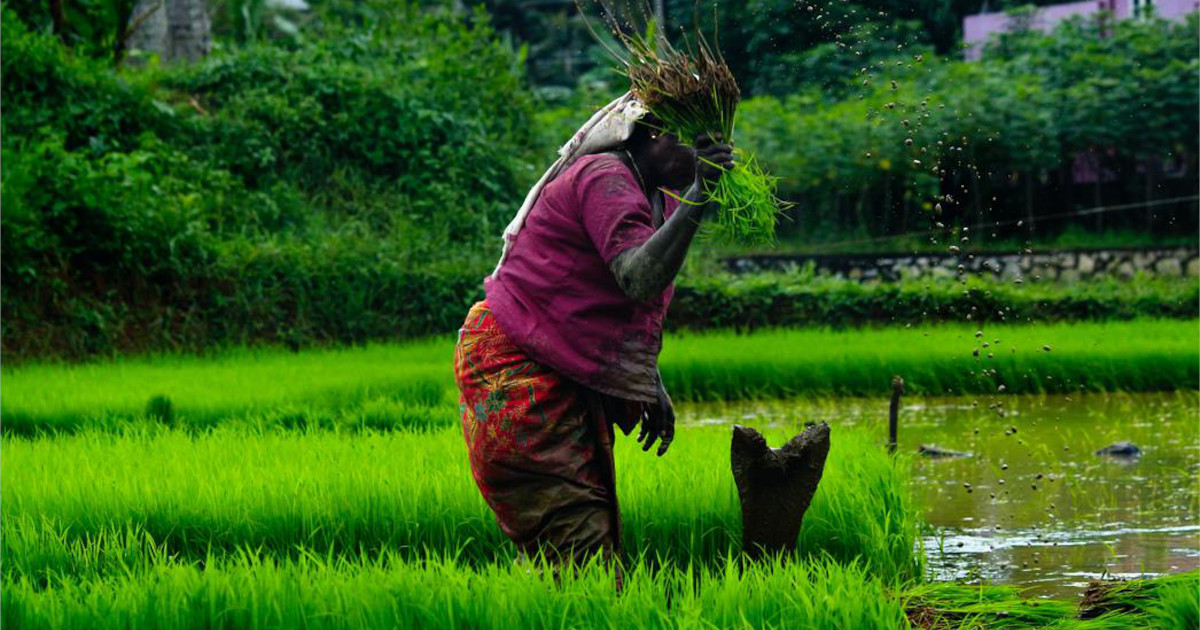
Indonesia has been the recipient of much of Garden’s funds. The companies there include a catalogue distribution business that engages about 250,000 agents, mainly single mothers outside of the main island of Java. For every sale the agent makes, they keep 25% of the receipts. The company, Paloma, has since been acquired by one of Indonesia’s largest conglomerates, Salim Group. There’s also a green technology company, Greenhope, that’s looking to provide employment for 2000 cassava farmers. In such an expansive archipelago as Indonesia is, access to educational materials is extremely uneven. Mahoni, a Garden-backed company, has been leveling the playing field by providing e-books and online resources to teachers and students, making it the leader in the digital education sector in Indonesia.
“So it just shows you,” Dr Tan concluded. “You can build these kinds of businesses that impact the poor specifically and intentionally, and yet be profitable.”
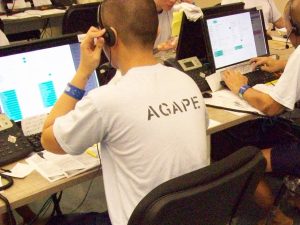
In Singapore, investments have gone into a call centre manned by prison inmates and ex-convicts. Agape Call Centre employs prisoners and pays them the minimum wage of US$430. Plus commissions and bonuses income can go up to US$1500.
Agape Call Centre
“What we’re seeing there is it restores their self-esteem,” explained Dr Tan. “They have money to send back to their families. Families start to visit them. When they come out we rehire them in the call centre outside. Outside we’ve got 60 people currently and the great thing is they don’t have to hide their background because the founder is an ex-con, the former CFO is an ex-con. They feel that this is family, there’s a sense of belonging, they can support one another.”
Screening the investees
Dr Tan claims a near perfect success rate in his investment record save for two ventures in Asia. One was a fish farm among a tribal people in Malaysia. A year and half into the partnership with about US$70,000 invested, Dr Tan called it quits after attempts to get regular updates on the financials from the entrepreneur failed. “That’s the one lever that we have in a lot of the businesses,” Dr Tan explained. “We need to control the finances. In all our businesses we get them to have a projected cash flow that needs to be updated on a weekly basis. If we want to we can go in and do an audit and say ‘Are these invoices real?’ And we need to know when the next funding round needs to happen so there’re no surprises.”
Dr Tan is matter-of-fact about the failure: “The principle is very simple – fail cheap, fail early.”
In screening investees, the priority rests on the financials. Dr Tan unapologetically puts on his VC hat and assesses the business for its potential to scale. “If they can’t be profitable, they’ll just become charities,” he said objectively.
The second screen is to examine the company’s pitch book. “What problem are you trying to solve? Who are you trying to serve? What kind of product or service are you trying to provide for the poor?” down the wire he went. “We’re very intentional about tackling poverty. Everything has to be how are we serving the bottom of the pyramid.”
From here, the decision-making becomes more visceral. Having seen enough business plans fail, Dr Tan is adamant that the success of the partnership rests on the people he invests in. “We’re investing in people, not investing in the business plan, not investing in technology. Business plans fail. They’re always wrong, usually wrong on the negative side. Technology will fail. So, we’re investing in people.
“It’s got to be about integrity, honesty, hard work and, most important of all, for us, a sense of modesty because for us this is a long-term marriage. We’ve got to like the people,”
Beyond just chemistry, Dr Tan is clear about the reasons for this stringent list of personal qualities. “Running a business and employing three people is very different from running a business and employing 300 people. Unless they have a sense of humility and modesty about them, they will not be teachable. They will not be willing to employ people smarter than them,” he insisted.
“So we spend a lot of time with them – do we like them, do we trust them, are they teachable, is she responsive.”
With such intense scrutiny, it’s inevitable that Dr Tan’s travel schedule is packed. He spends 60% of his time away from home and this has been with a cost. “When James was going to school at 11 years old,” he recalled of his younger of two sons, “Every time I’m away he’d go to school crying and the teachers will know. It’s involved sacrifice.” His wife, Sally, has had to hold the fort and he calls her his “rock”. Today, with two grown-up children (one of them has joined him at Springhill) she travels with him when his itinerary is not packed back to back.
Dr Kim Tan is a rare combination of George Soros and Mother Teresa. He has a nose for good businesses and an eye for growth potential (and, of course, the coffers to boot) yet he also has a heart for the disenfranchised and the underserved. This can only be summed up by a special dispensation offered to the few who have the onerous task of great responsibility with great power.
27 May 2020 — What do you do each time you stake a multi-million dollar investment and are struck by downturns? Time and time again.
That’s been the persistent tune in the playlist of the Popiah King, Sam Goi of Tee Yih Jia Manufacturing, and the executive chairman of SGX-listed GSH.
Privately-owned Tee Yih Jia was established 50 years ago and it was the spring roll or popiah skins that the company manufactures under its flagship brand Spring Home, all 40 million a day, that gave Goi his title. GSH is his property arm with its footprint in Singapore, Malaysia and China.
Since the sudden passing of his younger son early last year, Goi has kept a low profile. In this rare interview with him on Business Unusual, I quizzed Goi on lessons he could apply in his 50 years of building his billion-dollar businesses. Goi conceded that the effect of the coronavirus, compared to the other crises he’s been through is “a hundred times” worse. But this steely business leader is taking it all in his stride.
“In 1987 during the (oil crisis) I built a new factory. In ’97 (during the Asian Financial Crisis), I also built a new factory. Now, with Covid-19, I’m building my biggest factory,” said Goi, referring to a S$400 million automated cold storage warehouse he’s building beside his current factory in Singapore.
To add to the list of inopportune investments, when he acquired the 5-star 1000-room resort in East Malaysia, Sutera Harbour Resort, in 2014 he was greeted two months later with the shocking disappearance of the Malaysia Airlines plane en route from Kuala Lumpur to Beijing. The anger of the Chinese over Malaysia’s handling of the missing aircraft led to a backlash: Chinese tourist numbers plunged significantly. Almost overnight, occupancy at Sutera Harbour slipped to 40%.
For Goi, it is all about keeping faith and staying the course. “You must be confident in yourself”, he asserted.
When I probed further, I discovered that this confidence isn’t just a nebulous self-belief. The key to his ability to stay the course is his strong conviction to keep gearing in control.
Gear Low to Stay High
“I’m always worried about gearing too high. I seldom take up loans from the bank for my business,” he revealed. If it were up to him, he said, he would ensure loans were no more than 20% of the asset. In this way, even when things go south, he can keep things going. Any more leverage than that, Goi said, and it’ll be very challenging, like the effects of this Covid-19 crisis.
But prudence has paid off. With S$113 million in cash and cash equivalent in GSH’s coffers in 2019, Goi is confident in riding through the crisis.
“Our cash flow shouldn’t be a problem because we are a listed company and we don’t borrow too much money. We have cash in the bank until the end of next year,” said Goi. GSH’s current ratio in 2019 was a very healthy 2.1.
Expend Before You Expand
Other than a strong cash position, Goi is also conservative in his expenditure. In his food manufacturing business, expansion must be justified by demand. “If there’s a shortage (of production), we work overtime, even Saturdays and Sundays. But if we still can’t cope with demand, then we will buy a new machine and expand,” Goi said.
He reveals that the food manufacturing business is not a get-rich-quick venture. His investments can take between 10 and 30 years to reap returns. Clearly, a strong cash position helps in the building of patient capital.
In the light of the world recovering from the pandemic, it is a rare chance for businesses to hit the reset button. Perhaps it’s time to re-look the glorification of companies with insane valuations – companies that are running on the fumes of media spotlights, venture capital infusions, and the fickleness of consumers driven by novelty more than real value. Perhaps good old-fashioned/boring principles of keeping healthy balance sheets and building on real value may be the way forward. In view of how the pandemic is cleaning out the economy of debt-ridden businesses, that could just be the default position as the only companies that are left standing when the dust settles will be those that have been built on solid ground, not shifting sand.
For an excerpt on the interview – click here
To watch the full interview – click here
Whether you’ve just starting up or whether you’re in the growth stage of your business, you must hear what Binh Tran, partner of Silicon Valley-based 500 Startups Vietnam has to say. With investments in over 60 companies in the region, find out what he’s looking to fund, his advice to his business owners, and how he’s helping them through the crisis and after. Also featured is Jef Ong of Flexiroam chipping in with how he’s doing in the slowdown.
Get in on the conversation with the founder of Indonesia’s best-selling mass-market bread Sari Roti, to find out how she’s working through the lockdown, quarantines, and disruptions to make sure her bread sits in the pantry of Indonesians right across the largest archipelago in the world. Find out how Wendy Yap is working through this pandemic and finding opportunities in this crisis.