15 February 2022 — The biggest lesson I learnt was how much I don’t know.
That was Emma’s takeaway after 3 months of interning.
My daughter is taking a gap year before university. She said she needed the time and space to figure herself out after the rush and gush of major high school and college exams over the last few years. I’d say if that was her objective, then mission accomplished.
We laud and celebrate victories and breakthroughs of success. But we undervalue lessons that are underwhelming. The ones that tell us what not to do, insights that point out what we don’t know and revelations that show us what don’t add up.
Those are learnings too. As Thomas Edison said, “I didn’t fail. I just found 10,000 ways that something won’t work.”
Emma has come out of the short experience with so much more humility, an appreciation of the details that go into planning the apparently simplest of tasks and the dogged discipline of following through on a single of piece of work.
There was no reward for good work but there was something more valuable – insights and self-awareness. That’s a combination that can set her off on a higher trajectory than any recognition of a job well done.
We seldom work further on our triumphs. Instead, we plod on in the ones that elude success. In the pursuit of tangible and praise-worthy achievement, we gain greater knowledge, finer skills and enduring persistence in the negative space of the what-not-to-do’s.
So, here’s a thought – In our team appraisals, we could start asking the question what were some blind spots you discovered over the past year? What will you do about these?
Knowing what you don’t know is the beginning of wisdom.
4 February 2022 – In my coaching practice, I’ve found it supremely helpful to guide my clients to discover and/or articulate their values even before we dive in to any issue. Values are the true north of our behaviours. They are the litmus test to how coherent our actions are to our beliefs – we feel rested and at peace when what we do are in line with our values and we feel strangely conflicted and sometimes inexplicably stressed when our values and actions are not in sync.
Our core values are underlying traits that trigger us to react instinctively to situations. We feel a natural aversion to people who act opposed to these values and we intuitively steer towards people and circumstances that hold these characteristics true. Put simply, your core values are what you adhere to even when no one is watching.
Here’s my list of values that I offer my clients. They are deliberately overwhelming in number. This is to cause my clients to get in touch with what really matters to them so that they ruthlessly cut out what doesn’t resonate with them wholeheartedly.
Discover your values
The next thing I do is to talk about the selected values to help my clients decipher if those are truly what is irreplaceable for them. Very often, after searching themselves, clients would rethink their first draft and examine more deeply the values that truly represent them.
27 October 2021 – When leaders don’t ask for help, their people are worse off, according to organisational psychologist Adam Grant. The seasoned speaker and best-selling author was speaking at a closed gathering of coaches at the World Business and Executive Coach Summit (WBECS) recently.
Grant made the point that many leaders don’t ask for help for fear of looking incompetent, vulnerable and dependent. “If leaders never ask for help, the givers never come out of the woodwork,” he pointed out.
Not only are people denied the opportunity to render help and produce better outcomes, it also sets up a counter-productive culture where asking for help is seen as being weak.
This leadership behaviour has a “chilling effect” on an organisation and the message it sends to employees:
“If you look up in the hierarchy and you see that leaders have to project an image of competence all the time, then they’ll say ‘It is not psychologically safe in this organisation to ask for help. That is a sign of weakness’”.
This contrasts with help-seeking which can be seen as a source of strength, resilience and learning. In fact, to make it safe for people to ask for help, Grant suggested structures can be set up, like a Help Wanted post for staff to seek assistance so aid can be crowd-sourced.
In an interview with Marva Sadler, the CEO of WBECS, the Wharton professor provided data-driven insights to the pandemic’s effect on work and the role leaders play in his signature pithy responses to niggling issues organisations face.
Psychological Safety
Psychological safety is not a novel idea by any measure. It first emerged in the 60s and was reignited by Harvard professor Amy Edmondson in 2014. But the recent tussle between bosses and workers on returning to the office has raised this issue for employees on whether they feel safe enough to express their preferences.
The ball has to be in the leader’s court and mantras like don’t bring me problems; bring me solutions, have the opposite effect of creating a safe space for employees, said Grant.
“The foundation of building psychological safety is encouraging people to speak up about what is wrong – even if they don’t know how to fix it yet”.
Apart from asking for help, leaders asking for feedback can be a catalyst for building a culture of psychological safety.
Grant cited research that showed that leaders who openly spelled out their weaknesses and their development goals saw psychological safety spike and last for almost a year. He went on to give the example of Brad Smith, the CEO of Intuit, who took his 360 feedback from the board and posted it on his office door – the side facing out.
“If you’re a senior executive, the people who work with you already know what your weaknesses are,” said Grant, half in jest. “So, you might as well get credit to be secure enough to admit them and also to have the humility and the growth mindset to want to improve on them”.
In the light of The Great Resignation, where people are leaving their jobs in droves, Grant hypothesised that the inability to speak up freely in an organisation may be one of the push factors for people tendering their resignations.
“The lack of psychological safety has caused a lot of organisations to bleed talent”, said Grant.
Collective Effervescence
In the distancing and remoteness that have marked the last one and a half years of the pandemic, there has never been more of a need to find ways to reignite what sociologist Emile Durkheim calls collective effervescence. This is a state of synchrony and energy when a group of people gather with a common purpose. This results in an empowerment that would be non-existent in isolation. The dislocation, physical and emotional, effected by the pandemic raises the call to restart the collective engine on the new route we’re all taking.
Grant cited data on collective effervescence that showed that apart from interpersonal bonds, clear goals and roles are even more critical to set the momentum going. He defines clear goals as knowing what the mission is and why it matters and a clear role is knowing the link between the task and the mission. These, Grant pointed out, have been sorely missing in many leaders’ agenda.
In a stinging blow to those looking for quick-fixes to their staff’s well-being, Grant laid the cards out unapologetically: “I think we’ve been so focused on the ice-breakers and zoom happy hour, that we’ve forgotten that what people need to feel that collective effervescence is the sense that they fit in, they see that they’re part of something larger than themselves and that they stand out, they have a unique contribution to make”.
His parting shot:
“What that means for all the leaders who are struggling to get that sense of control right now is that it’s time for leaders to stop micro-managing and start macro-managing and give people that context they’re missing”.
A good crisis should never be wasted. In the context of Covid-19, we must be ready to hit the pause button and re-examine business as usual. Every aspect of the way we work, live, communicate, relate has changed fundamentally and it will never be in the same form as it was. The way leaders relate to their teams, whether it’s in motivation, innovation or communication must change.
In the face of less physical contact, surfacing context is crucial. In the past 18 months’ of reflections and adjustments, meaning and purpose have become a focal point of discussions.[1] As far as data goes, it is time for leaders to revisit their personal, organisational and employee purpose, find alignments, hit the reset button and shift their focus to what’s relevant now. This big shift requires courage and humility to do business unusual.
[1] Case in point, a Coursera programme on finding purpose and meaning by Vic Stretcher, professor of public health at the University of Michigan has seen triple the average Coursera enrolment during the pandemic. Participants were broadly representative across the globe.
24 September 2021 — Where for 40 years the idea of work-life balance touted by the women’s movement vacillated between whole-hearted embrace to outright dismissal, suddenly in a span of a few months, work-life integration is the only way forward.
Lockdowns and work-from-home arrangements have caused workers to confront the coexistence of the two major parts of our lives lived out in one place rather than, as it was in the not-so-distant past, a balance of separate realities demarcated by separate spaces.
Work-Life Integration Isn’t New
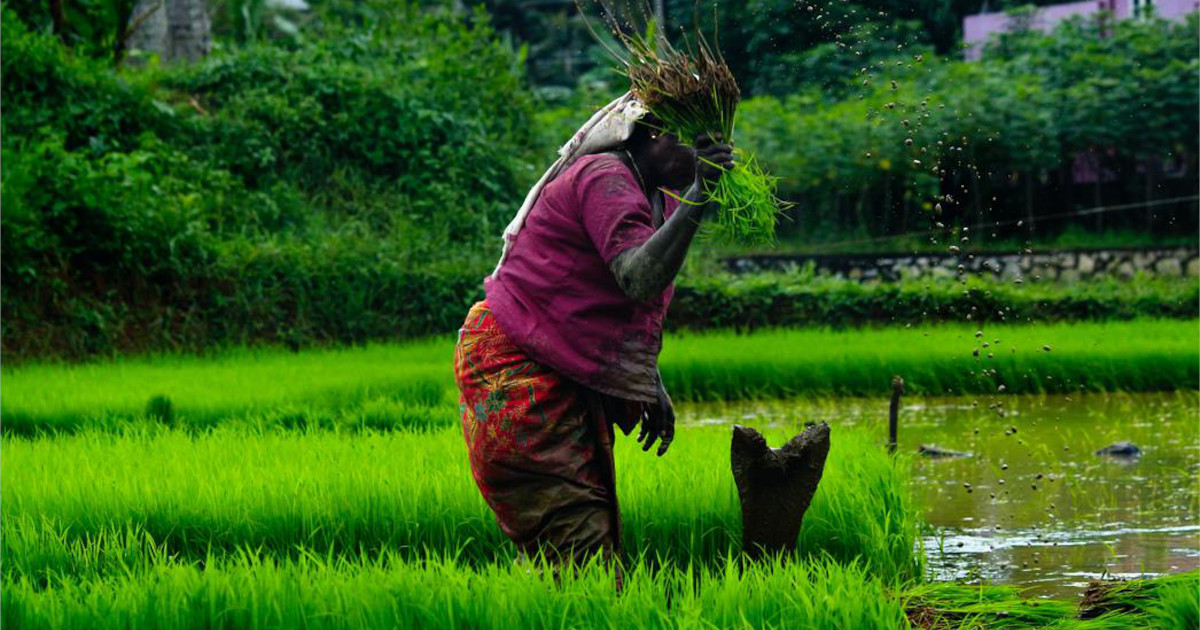
The separation of work and home was really the blip in human civilisation. In agrarian societies, the family, the home, and the land they worked on were one and the same. Division of labour was among the family and the boundaries between the home and homestead were fluid. It was the industrial revolution that brought people out of their homes into the factories which began the delineation between the two.
Three generations of family members live and work in Inn Kawashima
You may have unwittingly experienced this integration if you’ve dined in home restaurants or booked a room in a family home through Airbnb. While, as guests, we are thrilled by the novelty of the experience, the hosting family would have long established practices and lifestyles to merge their business with their personal lives.
I witnessed this when I stayed in a 70-year-old ryokan, a traditional Japanese inn, in Kyoto, now being run by the fourth generation. Ryokans have been around since 705 AD.
Inn Kawashima has 7 guest rooms. Other than the family space on the first floor, most of the other facilities are shared with guests.
Guests and family members meander through the narrow corridors, shared bathrooms, and courtyard. With the same smile the owners flash at guests, they greet returning family members.
As Megumi, the fourth generation family member was taking me through the familiarisation tour of the facility, her children sidled into the room out of curiosity and the topic of family slipped naturally into the introductions.
It was there that I witnessed this fluid merger of lifestyles, an acceptance of interruptions?—?by guests and family?—?and the flexibility of bending to needs without the artificial imposition of space and time.
Cultural adaptation is a skill humans possess in response to stressors in the environment. With the fundamental lifestyle changes remote work arrangements have brought about, it is crucial to change and remodel our perceptions and patterns of lifestyle.
Normalise Interruptions
Gone is the luxury of cloistering ourselves in a meeting room with doors shut and the sign that reads Meeting in Progress when we need uninterrupted time for meetings or planning. Families with young children will attest to that.
Flashback to 2017 when the world laughed in sympathy at the professor who was interrupted by his 2 children and wife during a live online BBC interview on probes in South Korea. Four years later we laugh in empathy with him, having experienced uncomfortable, if not downright embarrassing, moments of faux pas during our online work conversations.
Professor Robert Kelly being interrupted during his live interview with BBC
Now that the office has intruded into our homes, we need to normalise interruptions and accept the unexpected.
Welcome to life where dogs bark, cats jump on our laps, children squabble in the background, shirtless husbands wander. Apologise for the distraction but not for the natural rhythm of life. Laugh at the candid moments, say hello to wandering children, be curious about the package that just arrived at the door – and carry on. The less fuss we make of life as it happens, the faster we’re able to focus on work when it happens.
Mobilise your workspace
Since most of us work off a laptop, the option is there for us to shift our workspaces anywhere in the home that permits it – the kitchen island, the balcony, the porch, the children’s playroom. Of course, there are distractions along the way as you move into the shared spaces of the home but the point is to build flexibility into your working habits.
The challenge in this process is, firstly, our own mental models. If you’re the sort that has set places for set functions, you will find this
Spaces in the home can be reconstructed in the mind to accommodate the new lifestyle.
pattern very disruptive. But that’s what integration is all about – the willingness to dissolve the mental boundaries we’ve confined ourselves to and expand the plasticity of our routines.
If I need thinking time, I’ll hide myself away in a place that gives me solitude. It could be my original workspace, or it could be even in my lift lobby where no one can find me. But if I’m running through some routine administrative task or neatening the design and flow of my presentation slides, I’d be happy to work off my kitchen island where family traffic can be high.
The other hurdle to cross is the cooperation and consent of the rest of the family as unspoken lines that were drawn previously are crossed. This calls for conversations and an understanding of this changed reality and new rules to accommodate the new norm.
Actualise New Rituals
Rituals serve to link our practices with our values. As rituals in a church signify reverence for the subject of worship, so do routines tie our habits to our identity. Science has also found a positive correlation between rituals and the reduction of anxiety and stress.
The very familiar and comforting act of getting dressed for work, queueing the podcasts for the commute to work on the train, and the usual coffee pickup at the shop on the way to work cement for many of us our warm-up space for the workday ahead. With the loss of the rituals we have come to rely on to anchor our day, many would unsurprisingly feel thrown off, disoriented from the lack of boundaries and the exhaustion from not having the in-between spaces to refuel, recollect, and be reenergised.
A fresh vase of flowers to start a new work week can be a helpful mental and visual ritual.
Creating work rituals in the home can help to construct the work presence in the personal space. Getting out of the pyjamas and into a smartcasual outfit can be one way to prepare your mind and body for the work-from-home experience. Getting out of those clothes at the end of the workday can also signal for you the time to de-role even though the surrounding remains the same.
Signing in each new week with a vase of fresh flowers may also be a ritual to set for yourself to brighten the home and lift your spirits for the work week ahead. Or pasting a post-it with a quote of the day in your workspace to mark the start of the day or week could be another pick-me-up practice to get you going.
Grabbing my cup of coffee to start the day and another to signal the middle of the morning and tea close to the end of the workday are things I do to delineate the time. And the chit chat in the kitchen with family as I take the breather segues itself neatly into my home persona, as I take my “work voice” several notches down in projection and energy and joke with my children about the latest PewDiePie video (think water cooler chats, but with family instead of colleagues).
Having rituals established throughout the day to demarcate mental models of the workspace while seamlessly easing in and out of the work (mental) and home (physical) spaces will help to integrate the two.
If there’s anything the pandemic has taught us, it’s flexibility. With every wave of infection and changes in protocols, the only way forward is to bend. We are more adaptable than we make ourselves out to be. Yes, it’s inconvenient, uncomfortable and, yes, it involves letting go of set practices. But it’s well worth it if the outcome of integration is a net gain in productivity, relationships, and well-being – in whichever space you choose to be in.
My 82-year-old father-in-law, a survivor some of Malaya’s worst crises like the Japanese Occupation and the Emergency, has declared this Covid pandemic as the worst disaster he’s ever experienced. One year into the onset of the insidious spread of the virus and no one can say for certain when some light at the end of the tunnel can be glimpsed.
For businesses, it’s been one end of the pendulum or the other – for those who are left standing, it’s either survival mode or boom time. Whether in plenty or in want, volatility is the order of the day because the same reality confronts us all – what’s next? How do I deal with the ever-changing policies, standards, operations, demands, expectations, behaviours, data?
The best leaders, the enduring leaders, are made in a crisis. The divine dual ability to sink into the details in one moment and soar above them in the next is what makes them extraordinary. And one way they display their superiority is in their communication.
Meet in a frequent blend of interactions
In the initial stage of a sudden, or fast burn crisis, communication protocol demands the first holding statement be out within an hour of the incident. Thereafter, updates are given every three hours or less. In the second stage of the crisis when a search and rescue is still ongoing, for instance, and there are no significant developments, spokespeople continue to hold conferences to address various issues like technicalities, rumours and even emotional next-of-kin.
In times of business volatility, this second stage modus operandi should kick in. In small and medium organisations, engaging with staff every week should be expected, but in reality, is not common. There needs to be a blend of formal and informal engagements. Aside from the weekly updates, leaders must make it a point to have coffee chats among three or four staff members, small enough to have each person in the group feel responsible to keep the conversation going and big enough to feel the safety in numbers.
In large organisations, team leads must mirror these small group check-ins while having their own sessions to receive input from their leaders.
These interactions are there for leaders to show up and be present. Frequency is important to establish trust, consistency and accountability.
Frequency is important to establish trust, consistency and accountability.
Even if there’s nothing concrete to report (and that’s more often the case than not), use these sessions to listen, for that, too, is vital part of communication. You may elicit discussion around their challenges, their small victories, their ideas, and even their home front, recognizing that work and home are intrinsically linked.
Empathy over Facts
It’s a quality that is in great demand but short supply. And in times of ambiguity and uncertainty, when urgency compels activity, it is often neglected. But it is precisely in times of instability that the act of communicating heart to heart is highly needful. Empathy is the gift of holding the other’s soul – through trials and triumphs – in that moment of non-judgmental acceptance and revelation. It means, simply put, being human.
Empathy is the gift of holding the other’s soul – through trials and triumphs – in that moment of non-judgmental acceptance and revelation.
Alicia Tillman, the CMO of technology stalwart SAP, hit the nail on its head when she called out the need for empathy in the midst of the turmoil of 2020:
For me, empathy is what this year has been about…As a leader in and steward of the customer journey for a global organization, we need to dial in to the needs of our employees and our customers more than ever before and ensure that we’re responding with action that is significant enough to lead to the change people want to see.
The art of listening, reflecting and responding in mutual understanding is the job of every leader. If you approach these interactions, not just as a talk shop, but a fundamental and productive part of moving the agenda forward, you will find not just more motivated people but also useful insights, as Tillman reveals. Conversations about the challenges SAP’s customers faced and the solidarity SAP experienced with them resulted in free products to the market that targeted the most needful area of their business, like supply chains.
Authenticity
The main reason leaders avoid interactions in times of uncertainty is the discomfort in dealing with difficult conversations. MBA courses aren’t exactly skewed to skills you can’t measure. Authenticity is the posture of speaking and listening without masks and allowing space for honest, heartfelt disclosure.
Authenticity is the posture of speaking and listening without masks and allowing space for honest, heartfelt disclosure.
The first step is to recognize that you don’t have all the answers and having the courage to sit with the incompleteness. This is in no way a celebration of incompetence or ignorance. Rather, it is taking the initiative to open the floor to a shared humanity and by so doing, an invitation to others to contribute to the story bank of experiences and ideas which you all can use constructively to move things forward. Sharing stories of failing forward, if you will. The narrative you weave must be sincere to lend courage to listeners and create a bond of understanding. It is upon this commonalty that relationships are strengthened and unity is formed to push through the crisis.
Statements could sound like:
I want to say that it is true we have experienced a significant reduction in our order book. To that end, we are looking at alternative sources of income through an early release of some of our new projects. We are looking at all ways to boost our topline without going anywhere near headcount. For instance…
I know that many of you are unhappy about the way decisions have been made in what may seem to you like a haphazard way. It is hard be understanding when you have no view of the cockpit and are being tossed around by the turbulence. Let me just say that we are in the same aircraft and we’re going through the same motions as you. The decisions we have made have been done in consultation with our directors – I would like to think that we have put together the best minds. And we are aware that the changes have caused you a lot uncertainty and is just plain unsettling. I ask you to walk with us through this storm. We will all be affected, some more than others, but this storm will pass and we will be stronger for it.
Personal
Clarity is common clarion call in most organisation’s playbook. How about clarity with vulnerability?
When the pandemic first hit, Marriott International CEO Arne Sorenson was one of the first few leaders who got his video message out to staff globally. It was a textbook demonstration of empathetic communication, not just for the pedantic ticks in the boxes of what he said, but the sincerity and the vulnerability he displayed in referring to his “new bald look” after his cancer treatment, his admission that he has” never had a more challenging moment than this one” and with a crack in his voice, he reveals how painful it was to let go of staff.
While it is important in a crisis that leaders demonstrate control, in a prolonged drought with limited clarity in sight, inspiration is caught through deep bonds of unity when a leader can reveal his own struggles, his humanity.
In a prolonged drought with limited clarity in sight, inspiration is caught through deep bonds of unity when a leader can reveal his own struggles, his humanity.
Speaking in the first person, “I”, instead of “the company” or “we” or “the board” is one easy way to start:
I have sleepless nights asking myself, “What am I not seeing? What have I missed?”
I have been keeping late nights keeping our investors from around world in different time zones apprised of our situation.
Do I always have all the answers? No. But my job, together with my team, is to scour every nook and cranny for possibilities.
I was having a conversation with my 7-year-old the other day and asked her how her day in school went and she said, “I don’t know.” When I asked her what she’d learnt that day, she replied, “I don’t know.” And when I asked her what we could do together for fun, she responded, “I’m not sure, Mummy.” I think this sense of being out of our depth and being lost is what we’re all feeling.
Personalising your communication assures the recipient of a common humanity in times of uncertainty. Of course, a solid plan of action is a must. But more than that, where the outlook is fluid, the personal touch or even just a word of mutual understanding can be a shot in the arm and a source of inspiration to hope on.
In our hurry to fix what’s broken, it is instinctive for us to hit the play button to start doing and leave the talking on the back burner. But crisis communication is an intrinsic part of crisis management because it isn’t just what you’re doing, but what you’re seen to be doing, that’s part of the fix. So remember to communicate, connect and calibrate, because you’re not just fighting a fire, but you’re leading people through it.
Having started on webinars and virtual workshops, as most people did, at the start of the lockdowns, I was a noob at it. At least that’s what I thought.
As I got into the groove, I found many practices vaguely familiar. Then it hit me like a bolt – it’s television presentation all over again!
No wonder it was all so strangely familiar.
So, I’ve settled myself in very nicely with the advantage I have with years of television hosting.
Here’re a few tips that I’ve adopted and refreshed for presenting virtually.
Keep the one-way communication short
In a 30-minute programme, like Power List Asia, which I hosted for six seasons, there’ll always be two commercial slots fitted in – usually after eight minutes (if the math isn’t adding up for you, commercials take up about six minutes in total). So three eight-minute segments are produced with each having its own story arc and cliffhanger. The timing has been refined over the years considering the average attention span of a viewer.
This is confirmed by John Medina, professor of neurology at University of Washington, in his book Brain Rules. Medina says we can really only pay sustained attention to a consistent pattern for about 10 min before the mind wanders.
So, practice and theory converge to tell us to keep your spiel to less than 10 minutes at a go.
Here’re other considerations in an online setting that change the rules we normally play by in a physical context. The decorum our audience maintain by paying attention in a physical setting, is partly attributed to putting up appearances for people around them. Now that the witnesses are no longer there, the crime is free to commit. They can turn off their videos and hide their lack of interest to the drone on the other end of the line. That missing accountability coupled with the multitude of distractions at their workstations make it extremely challenging for a speaker to hold their attention.
If you can’t keep it that short, keep it varied.
Variety is the spice of life – and attention. Change the visual impact by mixing up your slide templates – textual, image, graphs, quotations, videos. Don’t forget to swap the image back to you by stopping the slide share even mid-way through the presentation when a discussion is happening, This will help to focus your audience’s attention on you and the exchange of ideas among the participants.
If it’s a group presentation, tag the other presenter at about the eighth to tenth minute. Introducing another speaker, even if it’s to give a testimonial, will be a helpful stimulus to recapture interest.
In a training scenario, I build in mini exercises and break out into smaller groups more often than in a physical setting.
Hearing other voices helps: I call on participants to share their perspective. Of course, the onus is on me to craft provocative questions to elicit a conversation. Having a co-trainer chime in with a different perspective and take over at different times, if you can afford it, helps to keep the workshop going for as long as one and a half days.
Use your to voice to captivate
I have huge respect for radio presenters. One of their biggest challenges is the fact that they have nothing but their voices and content to grip the listener. In television hosting, we have the added advantage of half our bodies to convey our message. It still does not negate the need to modulate our voices as we relate a story.
Varying your pitch, pace, volume and adding rightly-timed pauses are par for the course for building expression and repertoire to your vocal delivery.
I recommend recording yourself by reading out loud for about five minutes, playing it back and assessing how alive you sound. Mark out the article you’re reading with indicators like
“//” to indicate pauses (usually between paragraphs),
underline words that make a difference to the meaning.
“()” for sentences that you can read quickly
highlights for conclusive statements that require a slower pace
? for a happy note
? for a serious note
Practise regularly. Good vocal variety does not happen overnight.
The acid test – if you do lose interest in yourself during playback, then you need to work harder. You could also let someone else listen to the recording for a more objective assessment.
Work doubly hard to be energetic.
With enough distractions in your listener’s field of vision, speakers must muster enough energy for it to be felt through the camera onto audiences’ devices. I found standing throughout my delivery a sure-fire way for me to keep up the verve. If I can take it easier – during a discussion, for instance – I would lean on a high stool for support and stand again when it’s show time. Nevertheless, I highly recommend standing when you’re presenting virtually. The difference you’ll feel is significant. More importantly, how your audience feels is crucial.
I’ve been framed!
The power of physical meetings is the advantage to use our entire body to communicate – from the way we angle our feet and torso to the way our arms work with our facial expressions and the freedom to shift our positions for variety and meaning. Video conferencing, for the most part, removes those advantages from us with the limitations of our webcams and physical space. You could say our webcams disembody us. For some of us, we become, literally, a talking head, while others, a live bust, visible from head to upper chest.
Here’s what I’ve learnt from my experience as a news anchor: studio directors have generally agreed that the more of the presenter is seen, the greater the presence. So, given that we are most often seated throughout the entire show, the best framing would be to have the presenter be seen from head to waist.
I’ve found that standing a distance away from the webcam to capture my gestures as I speak, has helped me to communicate with my upper body, and not just with my facial expressions.
To do this well, keep your camera lens at eye level so you’re not looking down nor up, but straight ahead. This may mean raising your device and not merely tilting it. You’ll know if it’s level when the vertical lines around you are perpendicular to the bottom of your frame.
Watch your backdrop
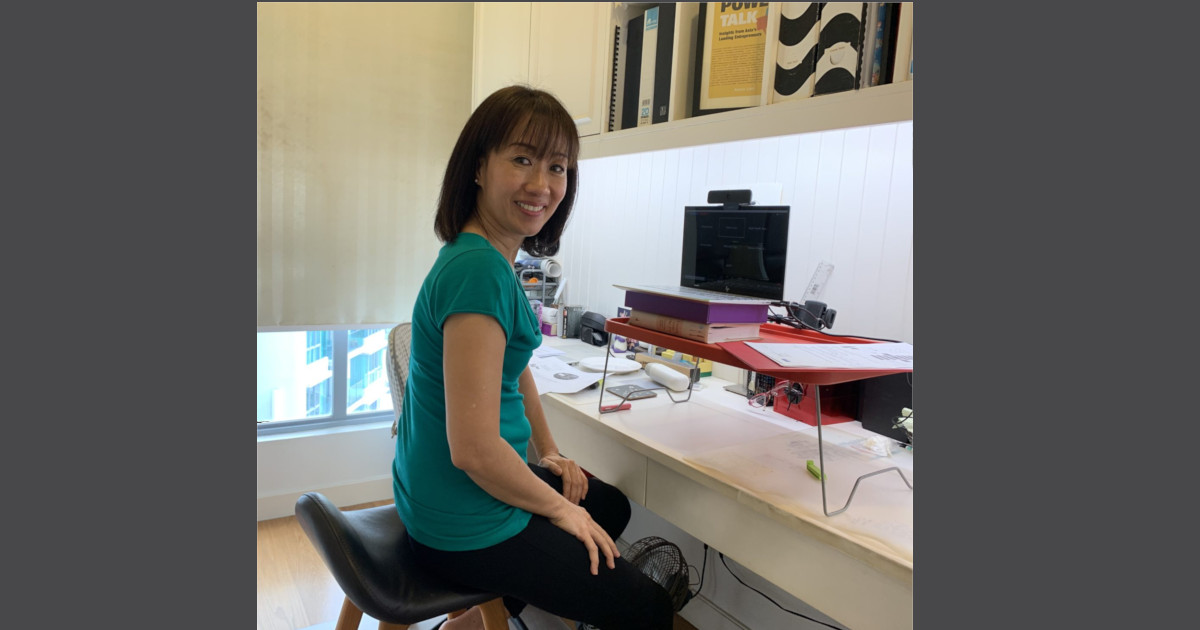
My webinar backdrop. Plant from my garden to add some height variation to the image. Note the improvised backlighting – a common feature in TV interviews
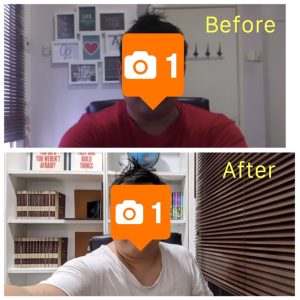
For our television interviews, the producer would recce the location days ahead to ensure we have the right spot for the conversation. There’re many considerations and if most of the boxes are ticked but not the backdrop, the crew would turn up hours ahead of time to set it up. Furniture would be moved, plants from the garden brought in, articles in the room shifted to that right spot for the frame. Your backdrop is to your image as accessories are to your outfit – they complement and enhance your look. The bookshelf behind the speaker suggests someone who is erudite and learned. Defocused photo frames on the wall expand my perspective of the speaker to the relationships and interests he has outside of the professional context. It doesn’t have to be an expensive set up. Just a considered, intentional arrangement that’s non-distracting.
Avoid virtual backdrops. They cut out parts of your image when you move and they’re just passe and simply too expedient/lazy.
Worked with a CEO of a tech company to set up the most appropriate backdrop for his high level discussions from his home
Ensure adequate lighting
Your main visual communication is your face. So, make sure you’re properly lit with the lighting in front and not behind you. If you’re fortunate enough to have your workspace well lit with natural light, good on you. If you don’t, you can get those halo selfie lights (I hear they’re flying off the shelves, so don’t be embarrassed about buying them) or just a standing or table lamp. To make the light less blinding on you and harsh on your image, get some baking paper or tracing paper to cover the lamp to diffuse the light source (improvisation is the order of the day!) White or day light is what I would recommend for a more natural look.
I happen to have concealed lighting at my workstation behind my webcam. The light bounces off the white panel in front of me to give my face good exposure without the harshness of direct lighting.
With these tips, you should be on your way to hosting your own Youtube channel soon!
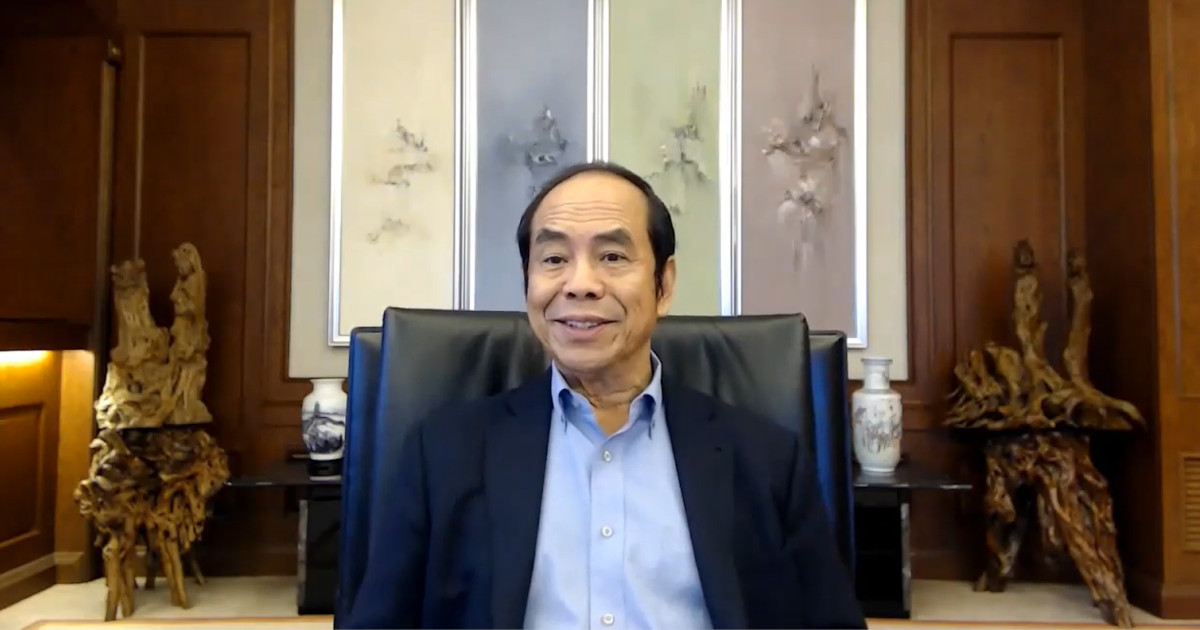
16 June 2020 — At 65, Dr Kim Tan is riding on the third wind of his career. Having started out as a biochemist before becoming a biotech venture capitalist, he had thought retirement in 2003 would slow things down for him. But it was not to be. “Retirement is hard work!” he declared when I met him at the Royal Society of Medicine in London where he’s a Fellow. He welcomes me warmly, offsetting the mad-professor image that he cuts with his tousled salt and pepper hair. I was mindful that I had about an hour with him before he had to scoot off to a talk he was giving at the British Malaysian Society.
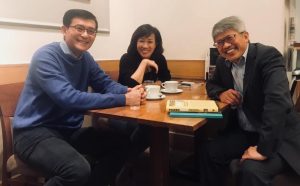
Kim Tan (right) chatting with my husband and me at the Royal Society of Medicine.
Marathon runners would understand the significance of the third wind – that last burst of energy that surges through the body just when they think they’ve all but burnt it out. Ask him how busy he is today and Dr Tan answers in specifics – he has an average of 80 emails in his inbox daily, he travels for board meetings, meets with his multiple investees, gives talks and teaches in bible schools. Everyone wants a piece of him as he sits as chairman of Springhill Management (UK), Inqo (SA), Garden Impact Investments (Singapore), partner of Novastar Ventures (Kenya) – companies that manage funds for social impact investing, some of which include the sovereign funds of Norway and UK that lead investments alongside foundations like the Bill and Melinda Gates Foundation and Chan Zuckerberg Initiative. He is also an advisor the the Johnson and Johnson social venture fund and the leading proponent of the impact investment group, Transformational Business Network, that has garnered over 2000 members from around the world.
Social impact investing is an asset class that looks to support businesses with the aim of reaping social and financial dividends. These businesses provide goods or services and employment for the disadvantaged and returns will typically be lower and take a longer period than other investments.
Modus operandi
For Dr Tan, it’s crucial to know his investees personally and the environment they work in. That would entail visits to the slums of cities to witness the poverty and dire needs there. “When we come out of the slums,” Dr Tan revealed, “our shoes always need cleaning!”
Through capital, leading in most instances to equity, and mentoring, Dr Tan and his various funds have invested in about 30 businesses in Africa and Asia with very clear outcomes. Investee companies must reap economic benefits and have the capacity to scale up while producing products or services for the poor and providing employment for them. Your proverbial do good and do well equation. Novastar in Kenya, where he is a partner manages a fund of US$160 million.
One of the star investments of the fund is the largest chain of low cost schools in Africa and India, Bridge International Academies, an investment Dr Tan made with other angel investors before Novastar was set up. He speaks of it like a proud father citing the higher than average results of the students, all 500,000 of them. The institutions which started in 2009 provide primary education. “We think for a country to develop, the masses need to be literate,” Dr Tan asserts.
Other impact investment organisation making inroads into various parts of the world include Acumen Fund, Vital Capital and Alphamundi. And traction is gaining as more investors realise there now exists an asset class that not only produces decent profits but has explicit social returns. Impact investment in Southeast Asia has seen a spike by private impact investors (PIIs), like fund managers, family offices, banks and foundations, since 2013. In total US$904 million was invested by PIIs in the region during that time in the area Environment, Social and Governance (ESG). Furthermore, financial institutions like Singapore’s state bank DBS has tailored an ESG portfolio for their next generation of private banking customers who are as concerned about growing the value of their investments as they do about doing good. Observers note that millennials, the next cohort of leaders, are more in tune with social causes than their parents’ generation and see impact investing becoming more prominent in time to come.
Damascus Road
Kim Tan’s conviction to fight poverty is personal, growing up poor himself. Being one of 10 children of an immigrant father from China who’d settled in a small town in Malaysia, running a provision shop, Dr Tan is mindful of living simply (he travels coach across the continents, just so you know). Dr Tan and seven other siblings received scholarships to study abroad. His took him to the University of Surrey where he completed his doctorate in molecular biology. He made his millions investing in biotechnology as a fund manager and was ready to go into retirement at the ripe old age of 45 when a family holiday to Cape Town changed the course and cause for him.
Even as he marveled at the beauty of the city, he was also not one to shy away from its privation. Dr Tan insisted the family visit a slum to see the other side of life. And it wasn’t so much the poverty and the unsanitary conditions that shocked him but it was the work done by the non-government organisations there that confounded him.
“What I saw just disillusioned me,” Dr Tan revealed. “These were good-hearted people, good intentions, really sacrificial people but they were teaching people to make clothes by hand – furniture, craft, shoes – by hand! Quality wasn’t there, quantity wasn’t there. And I thought, nothing’s going to change. We can give them as much charity money as we can each year, but nothing’s going to change.”
As it turned out, that experience became his turning point. “That was my Damascus Road moment,” said Dr Tan, referring to conversion experience of the biblical apostle, Paul. The futility of his giving until that moment hit him hard. “When you have some money the easiest thing to do is to write a cheque and feel good about yourself. What’s really hard is to give your time. That was really the beginning of a call to change career.
“I felt very clearly I was not to do anymore charity. I was to invest in the poor, in helping to build businesses among the poor that are sustainable and scalable. I fell in love with South Africa and thought, ‘I need to come back and build my first business here.’” said Dr Tan.
Two years of research and meetings led him to Addo Elephant National Park, the third largest national park in South Africa. Working with the local government, he bought up land and began to build a safari park with a luxury accommodation in it. Kuzuko Lodge was built with guests footing US$400 for a night’s stay. 39,000 acres of land was fenced up, the Big 5 – lions, leopards, rhinoceroses, elephants, and buffaloes – were reintroduced for the first time in 150 years. It was a painstaking process but one whose results Dr Tan is able to be proud of. Not for the financial rewards, which would only come 15 years later, but for the social and economic benefit to the community.
Kuzuko Lodge
“We genuinely wanted to come to help this very poor community. Several thousand population, 85% unemployment, 30% HIV AIDS.” Today, Dr Tan says, Kuzuko is the largest employer in the district, intentionally hiring disadvantaged youths and AIDS orphans and training them to be chefs, hotel staff and rangers.
The journey growing the business hasn’t been easy. “You’ve got to be really patient. They can let you down. They’ll fail you. They’re going to be drunk. They’re going to be stealing from you,” revealed Dr Tan, but it seems to be all in a day’s work for him. “This is what patient capital is about,” he shrugged, his eyes still on the goal. “In the end, you have to be profitable. Otherwise you become a charity.”
On what he learnt through the arduous process: “I learnt not to do it again. If you knew what was going to be involved you wouldn’t start,” he said, half-jokingly.
Looking East
While many are recognising impact investments as an increasingly attractive asset class, it is still low on the take-up. A Barclays survey, for instance, has shown that while 54% of investors in the UK are interested in the idea of their money making a positive social impact, a mere 9% actually put their money where their mouths are. It isn’t for the lack of returns. One group of VCs have cited a 9.5% return while Dr Tan’s Novastar fund aims to return up to 12% particularly for their investors. For some high net worth individuals in Dr Tan’s ambit, they would be happy with a 5% gain, still an edge over bonds with benchmark yields of 2-3%.
Then there’s the other category of investors who don’t ask for much “We have people who are donors from family offices who say they can’t take any returns,” he revealed. “We just give them their capital back. They’re the easiest. Zero return rate. It’s still a 100% return for them because if they give their money to charity, it’s zero return. You give them their capital back, they can recycle and reuse that capital.” Some funds seek an exit in seven years while others, those in the early stages, have a 10-12 year horizon.
While financial returns await investors at the finish line, the starting for Dr Tan is always with the right objectives – serving the underserved. Start with the right objectives, look for the opportunities, work at the business and it seems, profits will follow. “We almost make money by accident!” said Dr Tan.
Much of Dr Tan’s investments figure around Africa. It was only in 2013 that he began to look east. But it wasn’t as if he was a newbie to the business scene in Asia then. Back in 1999 Dr Tan had founded a cancer hospital in his home state of Negri Sembilian, bordering the capital Kuala Lumpur. The hospital has since been acquired by another company.
Dr Tan’s focus on Africa was purely out of need. “There is very little interest from these sovereign wealth funds to look at Asia,” he revealed. “The focus is very much Africa because they, like me, have the sense the economic engine in Asia is so powerful that it’s going to solve its poverty issue. It wasn’t’ until I went back to Indonesia maybe about five years ago and saw the 300 slums in Jakarta and thought, ‘Wow! The same kind of problems here as we have in Africa!’’
“The economic engine is powerful but the development is very uneven,” explained Dr Tan. “If anything, our GINI indexes are just growing wider and wider by the year. So that was when I then felt I should come back to Asia and do something.”
A chance meeting in Jakarta with some Singaporeans “who were in their mid life crisis” led to long conversations and the eventual setting up of Garden Impact Investments in the island state with a pilot fund of US$5 million to help companies in the region.
By his own admission the amount is a drop in the bucket compared to the other funds he manages. “It’s very small but we don’t need a lot of money. Convert it to rupiah, it goes a heck of a long way.” And investors have been more generous. “We’ve returned money but they don’t want it. They want to recycle. Fine!” said Dr Tan.
Indonesia has been the recipient of much of Garden’s funds. The companies there include a catalogue distribution business that engages about 250,000 agents, mainly single mothers outside of the main island of Java. For every sale the agent makes, they keep 25% of the receipts. The company, Paloma, has since been acquired by one of Indonesia’s largest conglomerates, Salim Group. There’s also a green technology company, Greenhope, that’s looking to provide employment for 2000 cassava farmers. In such an expansive archipelago as Indonesia is, access to educational materials is extremely uneven. Mahoni, a Garden-backed company, has been leveling the playing field by providing e-books and online resources to teachers and students, making it the leader in the digital education sector in Indonesia.
“So it just shows you,” Dr Tan concluded. “You can build these kinds of businesses that impact the poor specifically and intentionally, and yet be profitable.”
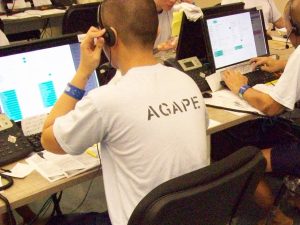
In Singapore, investments have gone into a call centre manned by prison inmates and ex-convicts. Agape Call Centre employs prisoners and pays them the minimum wage of US$430. Plus commissions and bonuses income can go up to US$1500.
Agape Call Centre
“What we’re seeing there is it restores their self-esteem,” explained Dr Tan. “They have money to send back to their families. Families start to visit them. When they come out we rehire them in the call centre outside. Outside we’ve got 60 people currently and the great thing is they don’t have to hide their background because the founder is an ex-con, the former CFO is an ex-con. They feel that this is family, there’s a sense of belonging, they can support one another.”
Screening the investees
Dr Tan claims a near perfect success rate in his investment record save for two ventures in Asia. One was a fish farm among a tribal people in Malaysia. A year and half into the partnership with about US$70,000 invested, Dr Tan called it quits after attempts to get regular updates on the financials from the entrepreneur failed. “That’s the one lever that we have in a lot of the businesses,” Dr Tan explained. “We need to control the finances. In all our businesses we get them to have a projected cash flow that needs to be updated on a weekly basis. If we want to we can go in and do an audit and say ‘Are these invoices real?’ And we need to know when the next funding round needs to happen so there’re no surprises.”
Dr Tan is matter-of-fact about the failure: “The principle is very simple – fail cheap, fail early.”
In screening investees, the priority rests on the financials. Dr Tan unapologetically puts on his VC hat and assesses the business for its potential to scale. “If they can’t be profitable, they’ll just become charities,” he said objectively.
The second screen is to examine the company’s pitch book. “What problem are you trying to solve? Who are you trying to serve? What kind of product or service are you trying to provide for the poor?” down the wire he went. “We’re very intentional about tackling poverty. Everything has to be how are we serving the bottom of the pyramid.”
From here, the decision-making becomes more visceral. Having seen enough business plans fail, Dr Tan is adamant that the success of the partnership rests on the people he invests in. “We’re investing in people, not investing in the business plan, not investing in technology. Business plans fail. They’re always wrong, usually wrong on the negative side. Technology will fail. So, we’re investing in people.
“It’s got to be about integrity, honesty, hard work and, most important of all, for us, a sense of modesty because for us this is a long-term marriage. We’ve got to like the people,”
Beyond just chemistry, Dr Tan is clear about the reasons for this stringent list of personal qualities. “Running a business and employing three people is very different from running a business and employing 300 people. Unless they have a sense of humility and modesty about them, they will not be teachable. They will not be willing to employ people smarter than them,” he insisted.
“So we spend a lot of time with them – do we like them, do we trust them, are they teachable, is she responsive.”
With such intense scrutiny, it’s inevitable that Dr Tan’s travel schedule is packed. He spends 60% of his time away from home and this has been with a cost. “When James was going to school at 11 years old,” he recalled of his younger of two sons, “Every time I’m away he’d go to school crying and the teachers will know. It’s involved sacrifice.” His wife, Sally, has had to hold the fort and he calls her his “rock”. Today, with two grown-up children (one of them has joined him at Springhill) she travels with him when his itinerary is not packed back to back.
Dr Kim Tan is a rare combination of George Soros and Mother Teresa. He has a nose for good businesses and an eye for growth potential (and, of course, the coffers to boot) yet he also has a heart for the disenfranchised and the underserved. This can only be summed up by a special dispensation offered to the few who have the onerous task of great responsibility with great power.
27 May 2020 — What do you do each time you stake a multi-million dollar investment and are struck by downturns? Time and time again.
That’s been the persistent tune in the playlist of the Popiah King, Sam Goi of Tee Yih Jia Manufacturing, and the executive chairman of SGX-listed GSH.
Privately-owned Tee Yih Jia was established 50 years ago and it was the spring roll or popiah skins that the company manufactures under its flagship brand Spring Home, all 40 million a day, that gave Goi his title. GSH is his property arm with its footprint in Singapore, Malaysia and China.
Since the sudden passing of his younger son early last year, Goi has kept a low profile. In this rare interview with him on Business Unusual, I quizzed Goi on lessons he could apply in his 50 years of building his billion-dollar businesses. Goi conceded that the effect of the coronavirus, compared to the other crises he’s been through is “a hundred times” worse. But this steely business leader is taking it all in his stride.
“In 1987 during the (oil crisis) I built a new factory. In ’97 (during the Asian Financial Crisis), I also built a new factory. Now, with Covid-19, I’m building my biggest factory,” said Goi, referring to a S$400 million automated cold storage warehouse he’s building beside his current factory in Singapore.
To add to the list of inopportune investments, when he acquired the 5-star 1000-room resort in East Malaysia, Sutera Harbour Resort, in 2014 he was greeted two months later with the shocking disappearance of the Malaysia Airlines plane en route from Kuala Lumpur to Beijing. The anger of the Chinese over Malaysia’s handling of the missing aircraft led to a backlash: Chinese tourist numbers plunged significantly. Almost overnight, occupancy at Sutera Harbour slipped to 40%.
For Goi, it is all about keeping faith and staying the course. “You must be confident in yourself”, he asserted.
When I probed further, I discovered that this confidence isn’t just a nebulous self-belief. The key to his ability to stay the course is his strong conviction to keep gearing in control.
Gear Low to Stay High
“I’m always worried about gearing too high. I seldom take up loans from the bank for my business,” he revealed. If it were up to him, he said, he would ensure loans were no more than 20% of the asset. In this way, even when things go south, he can keep things going. Any more leverage than that, Goi said, and it’ll be very challenging, like the effects of this Covid-19 crisis.
But prudence has paid off. With S$113 million in cash and cash equivalent in GSH’s coffers in 2019, Goi is confident in riding through the crisis.
“Our cash flow shouldn’t be a problem because we are a listed company and we don’t borrow too much money. We have cash in the bank until the end of next year,” said Goi. GSH’s current ratio in 2019 was a very healthy 2.1.
Expend Before You Expand
Other than a strong cash position, Goi is also conservative in his expenditure. In his food manufacturing business, expansion must be justified by demand. “If there’s a shortage (of production), we work overtime, even Saturdays and Sundays. But if we still can’t cope with demand, then we will buy a new machine and expand,” Goi said.
He reveals that the food manufacturing business is not a get-rich-quick venture. His investments can take between 10 and 30 years to reap returns. Clearly, a strong cash position helps in the building of patient capital.
In the light of the world recovering from the pandemic, it is a rare chance for businesses to hit the reset button. Perhaps it’s time to re-look the glorification of companies with insane valuations – companies that are running on the fumes of media spotlights, venture capital infusions, and the fickleness of consumers driven by novelty more than real value. Perhaps good old-fashioned/boring principles of keeping healthy balance sheets and building on real value may be the way forward. In view of how the pandemic is cleaning out the economy of debt-ridden businesses, that could just be the default position as the only companies that are left standing when the dust settles will be those that have been built on solid ground, not shifting sand.
For an excerpt on the interview – click here
To watch the full interview – click here
22 Feb 2019 – Singaporeans are not, if anything, dispassionate about our food. We go into a social media frenzy when other countries claim our food as theirs.
We are willing to spend an inordinate amount of time in food queues just to satisfy our palates. And so as we hear of more of our old favorites biting the dust and shuttering, we mourn deeply over the loss of yet another childhood fare – or is it another alternative to our national pastime?
It befuddles many minds why popular eateries like Moi Lum, one of Singapore’s oldest Cantonese restaurants, would serve its last dish in March after feeding many satisfied diners for 100 years. Then there are also the last suppers served by 55-year-old Chakey’s Serangoon Salt Baked Chicken and 63-year-old vegetarian restaurant Zen Fut Sai Kee.
All these businesses have taken the route to shut down because age has caught up with the owners and their children don’t want to take on the business. There is also an element of pride that has led to many closures. Without the next generation to hand age-old recipes down to, many proprietors would rather see the end of the road than to have their secrets commercialized or, worse adulterated.
An emotional decision to close
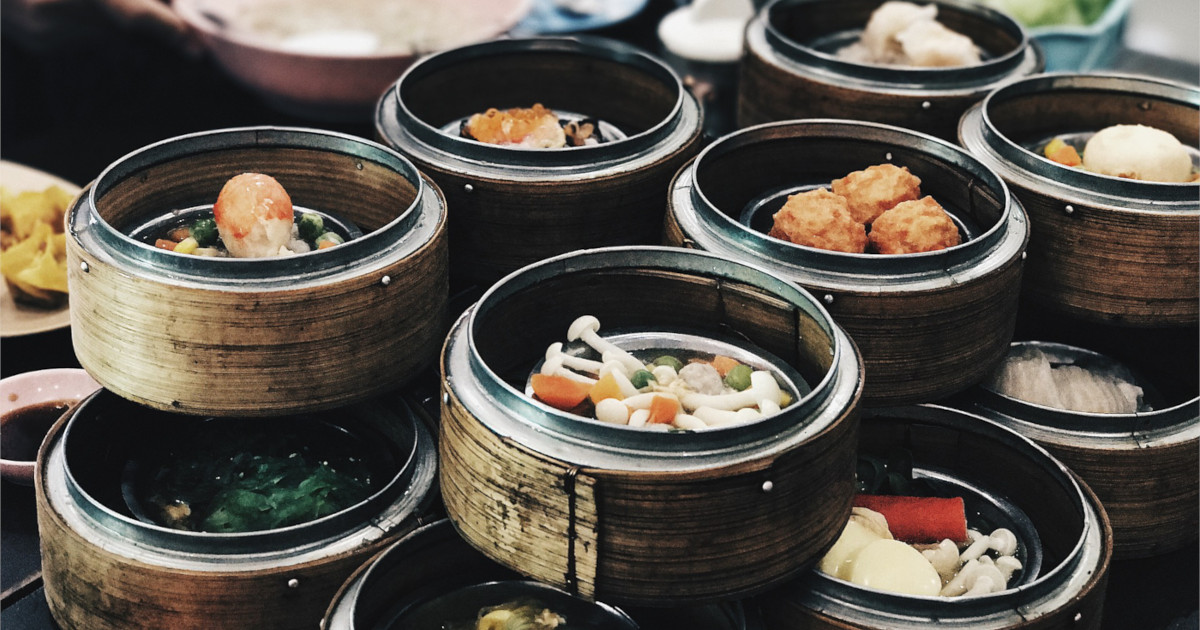
It was reported that the owners of a popular dim sum restaurant, Hua Nam, closed its doors in 2016 after making the traditional goodies from scratch for three generations. With no family members willing to take over, the owners opted to shut down to preserve the original recipe.
The dilemma for these traditional restauranteurs whether to continue the business is further complicated by the extremely challenging landscape quite unlike what they had experienced when they took over the businesses from their fathers in the 60s and 70s. High rentals, shortage of manpower, a saturated market with a smorgasbord of choices for the consumer make survival for small outfits with limited scale increasingly challenging.
The issue of succession is both an emotional and professional decision for family businesses. There are two broad areas in every business entity – management and ownership. Ownership refers to the shareholding while management, the operations. In most small businesses, ownership and management are one and the same.
In its simplest terms, succession can take three forms: First, it can take the happy outcome of ownership and management remaining in the hands of the family when the next generation is willing and competent enough to helm operations; Second, proprietors can employ professionals to run the daily operations while ownership and major decision-making remain in the family. Third, it can include other shareholders outside of the family who can steer operations and implement systems to ensure the company not only continues but is able to scale up.
As the options go down the wire, owners will likely feel threatened by the reduced control and share of profits. The nature of the food business lends itself to a certain pride of craftsmanship that makes relinquishing control akin to an identity crisis. Unlike manufacturing or property outfits, for instance, food businesses are typically started by chefs, not businessmen. In the early years, it was a matter of using their skills to survive.
As time passed and as their renown grew, however, much pride and passion were instilled in their art, more than their business. Chefs can be fixated on their products. Quality takes precedence over quantity. Expansion for them ought to focus on an elevation of their menu rather than an increase in the number of outlets.
But for the art to thrive, the platform on which it operates is just as crucial. For operations to grow there needs to be a driver who can focus on taking risks, expanding networks, and exploring opportunities.
In many of my conversations with Asia’s top entrepreneurs, passion for the product itself plays a small role in the growth of their businesses. It’s often the adrenaline rush they get when the business expands, when they solve an intractable problem, when they create successful brands, when the opportunity arrives to play a bigger role in philanthropy, or when innovation opens new doors. The combination of businessman and chef in one is a rare find.
The way forward if the business is to feed another generation is to take a leaf out of the books of those who’ve made a name from themselves as food entrepreneurs – or foodpreneurs.
Embrace systems and processes
International dim sum restaurant Din Tai Fung, famed for its xiao long bao, presents many lessons. The restaurant was started by Yang Bin Yi in 1972 in Taiwan. Word of his delicious wrapped soupy dumplings spread so rapidly that the seating expanded from half of their shopfront to all four floors of the lot in no time.
But it would take 24 years before the next outlet would open – in Shinjuku, Japan. A few years and further expansion in Japan led the food chain to finally open its own central kitchen back home in 2000. With the processes fine-tuned, outlets sprung up in quick succession throughout Taiwan. Consistency across all outlets was key, right down to each of their famous dumplings standardized with 16 grams of dough, five grams of pork, and folded in no less than 18 pleats.
Across their 150 outlets in 15 countries, Din Tai Fung is instantly recognizable with its glass-encased kitchens with chefs busily doling out the dumplings and other items on the menu almost by muscle memory. But all this clockwork precision takes effort. Owner Yang Chi-hua, the founder’s son, keeps tabs on operations by holding court in video conferences with branch managers daily.
Yang is of the rare breed of chef and businessman rolled into one. Not only has he been instrumental in expanding the business over the years, but he had also worked in the kitchen in the early years with the chef his father employed to start the business with. Yang has successfully balanced his penchant for maintaining the highest standards in food quality with the pragmatism of scaling up the operations at opportune times.
Finding the Right Partners
It’s said that Yang receives dozens of proposals a week from suitors looking to take the Din Tai Fung name to various parts of the world, as far as Russia and Mongolia. Most don’t get beyond his in-tray. For the owner, growth is not as much a priority as maintaining high standards. Finding the right partners along the journey is an instinct Yang seems to have honed over the years.
One such franchisee that Yang has partnered with in the last 16 years is Singaporean George Quek of the BreadTalk Group. Quek has led the charge since 2003 for Din Tai Fung in Singapore, Thailand, and most recently in the UK, with close to 30 outlets. Perhaps the key to Quek’s success is that he is both a franchisee and a franchisor, with his own stable of popular brands and an excellent feel of the markets he operates in.
Known as the King of Food Courts, Quek introduced Singaporeans to themed food courts in 1992 with Food Junction and has since fed the food fancies of Singaporeans with another food court, the Food Republic, local coffeeshop chain Toast Box and of course, the company’s eponymous bakery, BreadTalk. Today the Group runs 1000 outlets in 16 countries with numerous food brands under its management. Its last full-year revenue was close to S$600 million.
Here is a man who understands food trends, has an instinctive feel for consumer tastes and preferences, and dares to push the envelope in food presentation and experience. Quek’s innate feel of the food business began in Taiwan after dropping out of art college from a lack of funds. To make ends meet, he made and sold dragon beard candy in kiosks. He later learned to make noodles and introduced the Taiwanese to Singaporean hawker fare.
As a chef and business owner, Quek has developed the ability to sniff out a good brand and creates his own, and he has proven time and again, that he can serve up delectable returns for his partners and shareholders.
The science of business operations, the art of food
To sustain the food business for the long haul, owners must have the courage to operate apart from family members. While people are key to the success of any business, so are systems. Just as there’s an art to food creation, there is also a science to business operations.
Restaurant owners need to recognize the limitations of their gene pool and their own abilities and have the courage to share the responsibility of growing the business. They must also entertain the idea that quality and quantity can co-exist.
This can be a deeply emotional experience for one who has emerged from the shadow of the family business and who has retained sole ownership and decision-making for decades. But done with the right people and processes, heritage restaurants can continue to thrive and perpetuate not just the family legacy, but their gastronomic delights for generations to come.
(This article appeared in the Commentary section of channelnewsasia.com)
26 March 2020 – No one chooses to be the bearer of bad news. But leaders simply cannot run away from this responsibility. Yet, its delivery is as ominous as the crisis itself.
When Arne Sorenson, the CEO of Marriot Hotels, recently addressed staff in a video message on the hotel group’s response to the coronavirus crisis, he exhibited mastery over the art of delivering bad news with a balance of facts and emotion, determination and vulnerability and strength and concern.
The best-case scenario when delivering bad news is to engender the wholehearted support of the people who will bear the brunt of the crisis. Sorenson may very well have achieved that.
Opening with honesty
Sorenson dives straight into the objective of the video message with no fanfare and preamble. Here is a man on a mission with little time to spare for petty anecdotes and captivating openings. He gets straight to the significance of this message to him personally, branding it as “the most difficult video message we have ever pulled together”. He states from the outset he is invested in this crisis and is not shirking from his duty as the commander in chief.
He immediately pulls the heartstrings of his staff by acknowledging the behind-the-scenes discussion over the appropriateness of his appearance. He looked gaunt, tired, and had lost his hair from treatment for pancreatic cancer. It seems in PR practice almost counter-intuitive to show him in all his frailty at a time when the leader needs to be seen to be strong and in charge. But his self-deprecation in referring to his “new look” turns common practice on its head as he addresses the elephant in the room and takes control. He slides unobtrusively from his personal challenge to the “common crisis we face”, quietly stamping his selfless concern for staff.
Put people first
He segues into the business of the day by firstly addressing those who have been affected “as a patient, family member or friend”, expressing his concern for them. If anything, when delivering bad news to people, remember it’s the people and not the bad news that must stand out. This, Sorenson has done delicately well.
Be succinct and clear in delivering the facts
Sorenson points out unapologetically that the company has been winded by this crisis in spite of having been around for close to a century and having faced events like the Great Depression and World War Two. In fact, the prevailing crisis is worse that the recent meltdowns of 9/11 and the 2007 Global Financial Crisis, combined! It’s a bitter pill that cannot be sugar-coated. He pointedly presents the foreboding numbers – losses of 90% in China, while in other parts of the world, performance is down 75% below normal levels. This has forced hundreds of hotels to shut.
Clarity is what people seek in a time of crisis and delivering the sucker punch as it is, must be done. In many ways, that’s what brave leadership entails. Sorenson’s even tone as he releases the numbers reflects a leader who is determined to stare down the numbers.
Contingency Plans
All bad news must be met head-on with plans that are still within the company’s control. For the Marriot group, there’ll be a cut back in non-essential travel and a hiring freeze in most cases. There will be initiatives both at global and local levels, recognizing the autonomy of local operations who are better able to gauge their own needs.
Interestingly, Sorenson slips in a personal sacrifice in the middle of the litany of measures. He and John Marriot, the Chairman, will not take a salary for the entire year. In addition, the executive team will take a 50% pay cut.
Once again, this seems counter-intuitive from the standpoint of communication strategy. If he were to go to town about such a huge personal sacrifice, as most leaders would, he would’ve mentioned it at the start of the plans, or at the end. Known as the primacy and recency effects respectively, these are methods of emphases.
But burying his pro bono efforts for a year seems consistent with the self-effacing message he has been delivering. First, he brushes aside his obvious ill-health, expresses concern for those affected by the virus, and now, he mentions his own personal sacrifice almost as an aside.
This structure seems to work marvelously in drawing attention to the sincerity, and not the largesse, of the company’s leaders.
A light at the end of the tunnel
While being clear about the challenges and contingencies ahead, Sorenson begins his move towards the future. This is crucial for leaders in tough times, as workers look to them for hope and a vision. Without being overly optimistic, Sorensen points out some early signs of recovery in China as it emerges from the worst of the virus and begins to move the cogwheels of manufacturing once again. Slowly but surely, Sorenson claims, demand for lodging is showing signs of recovery as a result.
Sorenson is careful not to over-promise, stating “IF it holds, it MAY bode well” (emphasis mine) for the company moving forward. The tentative tone underlines the weight that Sorenson is mindful of bearing as he balances responsibility with optimism.
Vulnerability
In his penultimate message, Sorenson returns to the subject he started with and what apparently matters most to him – his employees. He reiterates how he’s “never had a more difficult moment than this one” and, for a moment, chokes slightly. With a barely audible tremble in his voice, he regrets having to tell his staff how they will be affected by the crisis.
To the skeptical, it may seem a matter of good showmanship. However, bearing in mind that this is a man who, in battling cancer, has had to deal with his own humanity, it may not be too far fetched an idea that he really was moved by the trail of disruption this crisis is leaving on the more vulnerable. The controlled emotion expressed over the difficulties his staff endears him even more than flowing tears.
Hope
Speaking in the tone of the great American frontiersmen, Sorenson concludes with his hope that when the crisis ends, “our guests will be eager to travel this beautiful world again”, opening vistas of hope and beauty, qualities in short supply in the current doldrums. Being the visionary that he is Sorenson calls on his staff to be ready, for “when that great day comes, we will be there to welcome them.” It would’ve been a picture-perfect ending, but not for the people person that Sorenson is. Instead of a grand gesture, he concludes with a routine encouragement to staff to take care of themselves.
Sorenson, through his sincerity, has demonstrated a masterclass in this unenviable task. It is a hard message to deliver and, as he is aware, a harder message to bear. But with his call to associates to keep their eyes on the rough and bumpy road ahead and their hearts on a new future, the staff at Marriot can still hold fast to what lies ahead – difficult as it may be, hopeful they must be.